

10 Effective Time Management Tips for Business Owners and Freelancers
The best time management tips for entrepreneurs and freelancers include planning your day in advance, setting clear priorities, using time blocking, avoiding multitasking, delegating low-value tasks, reducing distractions, and reviewing your progress weekly. Good time management helps business owners and freelancers work smarter, reduce stress, and focus more on growth.
10 Time Management Tips For Entrepreneurs and Freelancers
Entrepreneurs and freelancers often feel like there are never enough hours in a day. One moment you are handling client calls, and the next you are replying to emails, managing payments, planning content, attending meetings, solving team issues, or chasing deadlines.
The challenge is not always lack of time. Many times, the real issue is lack of structure.
Good time management is not about working all day. It is about using your working hours wisely. Whether you are a startup founder, consultant, freelancer, small business owner, or service provider, the right time management system can help you improve productivity and protect your personal life.
In this blog, we will discuss practical time management tips for freelancers, entrepreneurs, and business owners who want to stay focused, reduce stress, and grow with better planning.
Entrepreneurs and freelancers handle many roles at the same time. They are often responsible for sales, marketing, client delivery, finance, communication, planning, and problem-solving.
Without proper planning, the day can quickly become reactive. You may stay busy for 10 hours but still feel that important work is pending.
Good time management helps you:
- Focus on high-value tasks
- Reduce daily stress
- Complete work on time
- Improve client satisfaction
- Make better business decisions
- Avoid burnout
- Create work-life balance
- Spend more time on business growth
For business owners, time is not just a personal resource. It directly affects revenue, team performance, client experience, and long-term success.
This is why many entrepreneurs also work with a Business Coach to improve planning, accountability, decision-making, and productivity systems.
Common Time Management Challenges Entrepreneurs Face
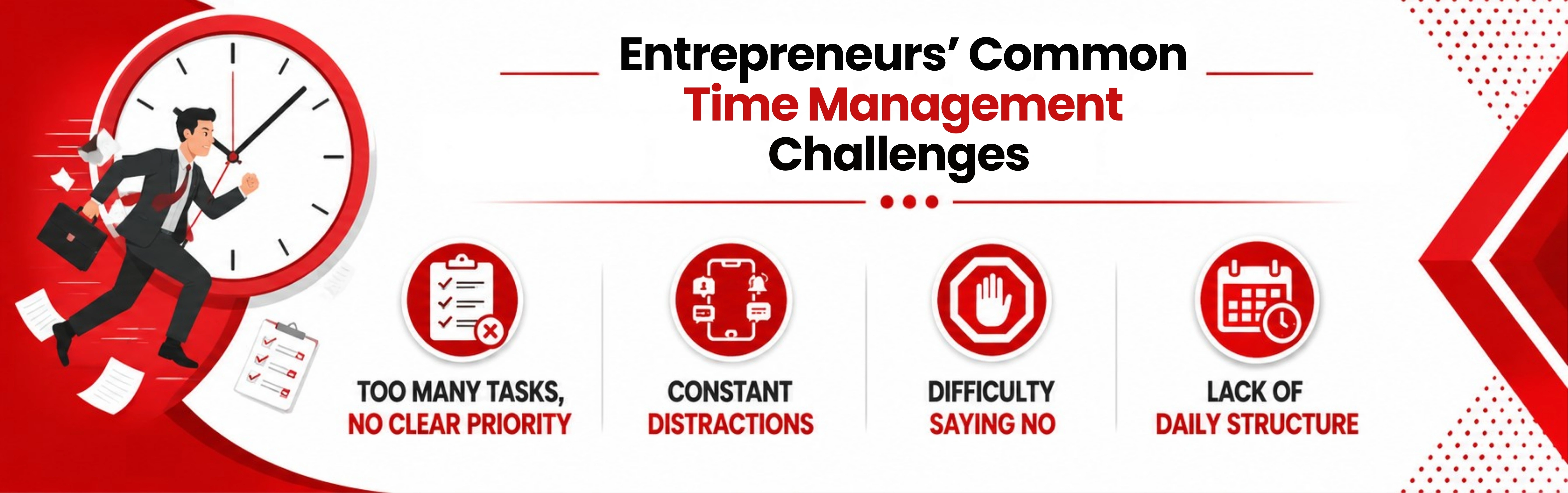
Before learning the tips, it is important to understand the common problems.
- Too Many Tasks, No Clear Priority
Entrepreneurs often try to do everything at once. Sales, operations, delivery, hiring, marketing, and admin work all feel urgent. But when everything is urgent, nothing gets proper focus.
- Constant Distractions
Phone calls, WhatsApp messages, social media, emails, meetings, and notifications can break your focus again and again. This makes simple work take longer.
- Difficulty Saying No
Freelancers and business owners often accept too many client requests because they do not want to lose opportunities. But overcommitting leads to missed deadlines and poor-quality work.
- Lack of Daily Structure
Without a plan, your day is controlled by other people’s demands. You may spend the whole day solving small issues and still not complete your most important tasks.
10 Best Time Management Tips for Entrepreneurs and Freelancers
Below are ten practical time management tips to help entrepreneurs handle daily tasks without feeling overwhelmed. You do not need to follow every method at once. Try the ones that suit your work style, combine what helps you the most, and build a routine that improves productivity while still giving you enough time to rest.
1. Start Your Day by setting smart goals and a clear plan
Starting the day with a clear plan is one of the most effective and simplest time management tips for entrepreneurs. A clear goal and a set plan reduce confusion and is helpful in giving directions.
So instead of randomly scrolling through messages and checking emails on a laptop, always prioritize tasks.
Best way to plan your day is by:
- Noting down the top 3 to 5 priorities
- Maintain a to-do list
- Ensure about important meetings and deadlines
- Have some spare time for absolutely urgent stuff
- Avoid completing unnecessary tasks as the first thing in the morning
These simple yet meaningful step will helps you on focus on what truly matters.
2. Schedule weekly and Prioritize High-Value tasks accordingly
Good time management for entrepreneurs starts with knowing which tasks deserve your best energy. Not every task gives the same result. Some tasks directly grow your business, while others only keep you busy.
High-value tasks may include:
- Client delivery
- Sales calls
- Proposal follow-ups
- Marketing strategy
- Team decisions
- Financial planning
- Product or service improvement
- Business partnerships
Try to complete your most important work during your peak productivity hours. For many people, this is usually morning or early afternoon.
Avoid spending your best hours on low-value activities like checking random messages, browsing social media, or doing admin tasks that can be handled later.
3. Use Time Blocking for Better Focus

This is one of the most useful time management tips for freelancers because freelancers often handle multiple clients and projects at the same time.
Time blocking means assigning a fixed time slot for a specific task. It helps you stay focused and prevents your day from becoming messy.
For example: setting a daily goal as the first thing in the morning. Then the next productive hour can be dedicated to do deep work which needs utmost focus or completing high- priority work. Then, during lazy hours sending follow-up mails and managing clients calls will be best to utilize the time in more organized manner.
Time blocking helps you give dedicated attention to each task. It also reduces the habit of switching between too many things.
These entrepreneur time management tips don't need any dedicated system just a simple daily planner diary, Google’s daily planner app or a notepad will be sufficient.
4. Avoid Multitasking and batch similar tasks
Many entrepreneurs believe multitasking saves time, but in reality, it is the complete opposite and instead increases the chances of mistakes and eventually consumes more time than what was needed.
Switching between emails, reverting back to clients, phone calls, and handling management task all at once reduces the momentum of brain. The task which can be easily completed within half an hour can take upto 2 hours all because of multiple interruptions and loss of focus.
The best way to practice that is by:
- Always completing one task at a time
- Setting a time limit for a particular task
- Keeping phones away specially during deep work hours
- Not scrolling through random tasks and emails
- Turn off unnecessary distractions
Multitasking may sound appealing, but Single-tasking improves speed, quality, and mental clarity. Because for an entrepreneurs and freelancers, focus is a competitive advantage. The more focused you are, the more valuable work you can produce in less time.
5. Delegate and Outsource Low-Value Tasks
Many business owners waste time because they try to do everything themselves. But growth becomes difficult when you are stuck in small tasks.
Delegation is one of the best time management strategies for business owners because it gives you more time for decision-making, sales, strategy, and growth.
You can delegate or outsource tasks like:
- Data entry
- Social media posting
- Basic graphic design
- Accounting
- Appointment scheduling
- Customer follow-ups
- Admin work
- Research
- Email sorting
If you are a freelancer, you can also outsource repetitive work to virtual assistants or junior professionals. Delegation does not mean losing control. It means using your time where it creates the highest value.
6. Set Clear Boundaries With Clients and Teams

Boundaries make your work more professional, not less helpful. These Freelancers' time management tips are especially important when handling multiple clients. Without boundaries, your schedule can quickly become overloaded.
Freelancers and entrepreneurs often lose time because they are always available. Clients message at any hour. Team members ask small questions repeatedly. Meetings happen without structure.
Thus, the most effective way to achieve this is to set clear rules for:
- Response time
- Meeting hours
- Revision limits
- Project timelines
- Payment communication
- Emergency communication
- Weekend availability
For example, you can tell clients that calls are available only during fixed hours and urgent queries should be shared through email or a project management tool.
7. Reduce Unnecessary Meetings
Meetings can be useful, but too many meetings can waste your best working hours. Many updates do not need a call. They can be handled through email, voice notes, or project tools.
Before accepting or scheduling a meeting, ask:
- Is this meeting necessary?
- Can this be solved through a message?
- Is there a clear agenda?
- Who really needs to attend?
- What decision should come from this meeting?
To make meetings productive:
- Keep them short
- Start with an agenda
- End with clear action points
- Avoid repeating the same discussion
- Use meeting notes for clarity
For business owners, fewer but better meetings can save several hours every week.
8. Use Productivity Tools Wisely
Productivity tools can help you stay organized, but only if you use them properly. The goal is not to use too many tools. The goal is to create a simple system that works.
Useful tools include:
- Google Calendar for scheduling
- Trello or Asana for task tracking
- Notion for notes and planning
- ClickUp for project management
- Toggl for time tracking
- Google Keep for quick ideas
- Calendly for appointment booking
Choose tools based on your work style. If you are a freelancer, a simple calendar and task board may be enough. If you manage a team, a project management tool can help everyone stay aligned.
Do not spend more time organizing tools than doing actual work.
9. Track Where Your Time Goes
Many people feel busy but do not know where their time actually goes. Time tracking helps you identify hidden time leaks.
Track your time for one week and see how much time goes into:
- Client work
- Meetings
- Emails
- Admin tasks
- Social media
- Team communication
- Sales calls
- Learning
- Unplanned interruptions
Once you see the pattern, you can make better decisions.
For example, you may realize that you spend 2 hours daily on low-value communication. Or you may notice that admin work is taking too much time and needs to be delegated.
Time tracking gives you honest data. It helps you improve your schedule instead of guessing.
10. Review your work and track your time to analyse your productivity
Time management is not a one-time activity. It needs regular review.
At the end of every week, analyse:
- Whether you were able to complete the daily goals
- Did you observed positive changes in your work
- Where able to Effectively manage time
- Were your able to give best results in prioritized tasks
- Did you observe some positive changes in your business growth
Weekly review helps you stay consistent. It also prevents small problems from becoming big delays. Though self-analysis is the best possible way to review your work progress but for a new and budding entrepreneur and a freelancer, sometimes getting help of a Business Coach is adviced to review priorities, remove distractions, build better routines, and stay accountable.
The goal is not perfection. The goal is steady improvement.
How a Business Coach Can Help With Time Management
Many business owners know what they should do, but they struggle with consistency. Coaching helps bring structure and accountability.
A business coach can help entrepreneurs and freelancers create better systems for planning, productivity, and decision-making.
A Business Coach can help you:
- Set clear business priorities
- Build weekly and monthly plans
- Identify time-wasting habits
- Improve focus and accountability
- Create delegation systems
- Manage workload better
- Balance growth and personal life
- Make better use of your working hours
Final Thoughts
The most crucial skill that entrepreneurs and freelancers must develop is time management. The ability to manage your time leads to better business organization, which decreases your stress levels and increases your work efficiency.
The best time management system requires users to follow three core principles, which make it both usable and dependable throughout their daily activities. Your daily schedule should begin with high-value task planning, which you will execute through time blocking while maintaining your work boundaries until your weekly progress review.
The path to business growth does not require you to extend your working hours. Better focus and better systems are needed for your work to be successful.
If you feel stuck, overwhelmed, or unable to manage business priorities, working with a Business Coach can help you create structure, improve accountability, and use your time more effectively.
Frequently Asked Questions
1. What are the best time management tips for entrepreneurs?
The best time management tips for entrepreneurs include planning the day in advance, focusing on high-value tasks, using time blocking, avoiding multitasking, delegating work, reducing distractions, and reviewing weekly progress.
2. How can freelancers manage time better?
Freelancers can manage time better by setting clear client boundaries, tracking deadlines, using project management tools, avoiding overbooking, batching similar tasks, and keeping buffer time between multiple client projects.
3. Why is time management important for business owners?
Time management helps business owners focus on growth, reduce stress, improve decision-making, complete important tasks on time, manage teams better, and avoid wasting energy on low-value work.
4. What are common time management mistakes entrepreneurs make?
Common mistakes include starting the day without planning, saying yes to every request, checking emails constantly, attending too many meetings, not delegating, multitasking, and not reviewing weekly progress.
5. Can a Business Coach help with time management?
Yes, a Business Coach can help entrepreneurs and freelancers set priorities, build productive routines, improve accountability, reduce distractions, and create systems for better time and business management.
6. What is the best time management strategy for freelancers?
One of the best strategies for freelancers is time blocking. It helps divide the day into focused slots for client work, communication, admin tasks, revisions, and personal time, making work more organized and manageable.