

What Is a Bad Practice While Speaking in Public? 10 Mistakes to Avoid
Most people think public speaking is about having a loud voice or using big words. But that is not true at all. In reality, even experienced speakers make mistakes that quietly kill their impact - and most of them never realise it.
After training over 1,00,000 professionals across India, Anurag Aggarwal - India's No.1 public speaking coach - has seen the same mistakes repeated again and again. Whether it is a student giving a class presentation, a manager addressing his team, or a business owner pitching to investors - bad habits show up everywhere.
This blog will walk you through the most common bad practices in public speaking, along with practical public speaking tips to help you avoid them and improve your delivery. Let’s get started.
Why Public Speaking Mistakes Matter
Understanding common Public Speaking Mistakes is important because a bad presentation does not just waste time - it can also damage your credibility. People form opinions about you within the first 30 seconds of hearing you speak. One nervous habit, one wrong body movement, or one filler word too many - and your audience starts losing trust in you. According to research, 75% of people suffer from speech anxiety, but anxiety alone is not the problem. Understanding the Importance of Public Speaking can also help explain why these communication challenges are worth addressing rather than ignoring. The real damage happens when bad habits go uncorrected for years. That is why identifying and fixing these mistakes early matters more than most people think.
10 Bad Practices to Avoid When Speaking in Public
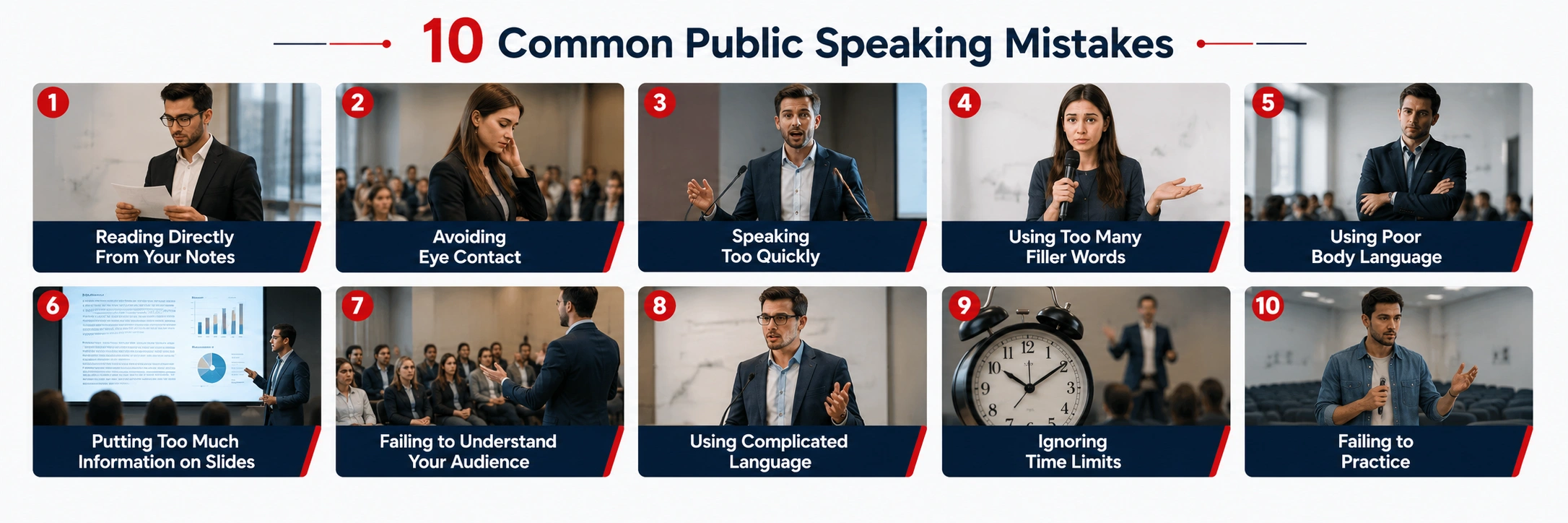
Every speaker wants to impress their audience. But sometimes without even realising it, we fall into habits that do exactly the opposite. Here are the 10 most damaging bad practices you must stop immediately.
1. Reading Directly From Your Notes
This is probably the most common mistake seen in public speaking - and one of the most damaging ones.
When you read directly from your notes or slides, you are not speaking to your audience. You are speaking to a piece of paper. Your voice becomes flat and monotonous. Your energy drops. And your audience starts feeling like they could have just read the content themselves - without needing you there at all.
The moment you break eye contact to look at your notes constantly, people stop trusting you. It signals one thing - you are not prepared enough. And an unprepared speaker is an unpersuasive speaker.
- Use notes only as a reference - not as a script
- Memorise your key points, not word for word
- Practice enough so that you only glance at notes occasionally
2. Avoiding Eye Contact
Think about the last time someone spoke to you without looking at you. Did it feel genuine? Probably not.
Eye contact is one of the most powerful tools a speaker has. It creates connection. It builds trust. It tells your audience - "I am talking to YOU, not just at you." When you avoid eye contact, you look nervous, unprepared and unconfident - even if your content is excellent.
Many speakers make the mistake of staring at the floor, looking at the ceiling, or fixing their gaze on one corner of the room. This disconnects them from their audience completely.
- Make natural eye contact with different people in the room
- Hold eye contact for 2-3 seconds per person before moving on
- Never stare at your slides or screen while speaking
3. Speaking Too Quickly
Nervousness makes people rush. And rushing is one of the biggest killers of a good speech. When you speak too fast, your audience cannot process what you are saying. They miss important points. They feel overwhelmed. And eventually they just stop listening. What is worse - you also lose control of your own thoughts when you speak too fast, which leads to more mistakes and more nervousness.
Slowing down is not a weakness. It is a sign of confidence. The best speakers in the world use deliberate pauses, a controlled pace and Powerful Voice Modulation to make their words land with full impact.
- Practice speaking at a pace that feels slightly slower than normal
- Use pauses after important points to let them sink in
- Record yourself to check your speaking speed honestly
4. Using Too Many Filler Words
"Umm... so basically... you know... like... actually..."
Sound familiar? Filler words are the invisible enemies of a powerful speaker. Every “umm and basically” you say takes away from your credibility. It signals to your audience that you are not confident in what you are saying - even when you are.
The problem is most people do not even realise how many filler words they use. It becomes such a habit that it happens automatically. Some people say umm 20-30 times in a single minute without noticing it.
- Record your practice sessions and count your filler words
- Replace filler words with silence - a pause sounds far more confident
- Practice answering questions without using a single filler word
5. Using Poor Body Language
Your words are only a small part of your communication. Research shows that over 55% of communication is body language. So if your body is saying something different from your words - your audience will believe your body every single time.
Crossed arms signal defensiveness. Slouched shoulders signal low confidence. Hands in pockets signal nervousness. Constantly shifting weight from one foot to another signals anxiety. These are all things your audience notices - even if they do not consciously realise it. Learning more about Body Language can help you understand how your posture, gestures and movements influence the way your message is received.
- Stand straight with feet shoulder-width apart
- Use natural hand gestures to emphasise key points
- Move purposefully on stage - avoid pacing restlessly back and forth
6. Putting Too Much Information on Slides
Slides are supposed to support your speech - not replace it. When you put paragraphs of text on every slide, two things happen. First, your audience starts reading the slide instead of listening to you. Second, you start reading from the slide too - which takes us back to mistake number one. Your slides should be simple, visual and minimal. They should add to what you are saying - not repeat it word for word.
- Use maximum 5-6 words per slide point
- Use images and visuals instead of long text
- Your slides are a backdrop - YOU are the presentation
7. Failing to Understand Your Audience
One of the biggest mistakes speakers make is preparing a speech without thinking about who they are speaking to. A speech that works perfectly for a group of college students will completely fail in front of a boardroom of senior executives. The level of language, the examples you use, the tone you take - everything must match your audience. If you do not know your audience, you cannot connect with them. Understanding different types of listening can also help speakers pay closer attention to audience responses, questions and feedback. And connection is everything in public speaking.
- Research your audience before every presentation
- Ask yourself - what does this audience already know? What do they want to know?
- Adjust your language, examples and storytelling skills to match the room
8. Using Complicated Language
Simple is powerful. Always. Many speakers make the mistake of using big technical words and complex sentences to sound more intelligent or more credible. But it has the opposite effect. Your audience gets confused. They feel excluded. And a confused audience is a disengaged audience.
The best speakers in the world - from great TEDx presenters to top CEOs - all use simple, clear language. Because their goal is not to impress - it is to connect and communicate. As Anurag Aggarwal always says - "If a 12-year-old cannot understand what you are saying, you need to simplify it."
- Use everyday words that everyone in the room can understand
- Avoid jargon unless you are 100% sure your audience knows it
- Short sentences always work better than long complicated ones
9. Ignoring Time Limits
Respect your audience's time - always.
Going over your allotted time is one of the most disrespectful things a speaker can do. It signals poor preparation and poor self-awareness. When a speaker keeps going beyond their time, the audience stops listening. They start checking their phones. They get restless. And even if your content was good - they leave with a negative impression.
On the other hand, finishing too quickly also looks unprepared. The goal is to fit your content perfectly within the time given, which is why strong time management skills are essential for keeping a presentation focused and on schedule.
- Always practice your speech with a timer
- Know which sections to cut if you are running short on time
- Finishing slightly early is always better than going over
10. Failing to Practice
This is the root cause of almost every other mistake on this list.
Most people prepare their content but forget to practice their delivery. They know what they want to say - but they have never actually said it out loud before standing in front of an audience. And that is where everything falls apart.
Practice is not just about remembering your content. It is about getting comfortable with your own voice, your pace, your body language and your energy. The more you practice, the less nervous you feel. And the less nervous you feel, the better you speak. It really is that simple. You can also explore our Public Speaking Course to get structured guidance and real practice sessions with expert feedback.
- Practice out loud - not just in your head
- Practice in front of a mirror or record yourself on video
- Practice in front of real people - friends, family or colleagues
What Should You Do Instead?
Knowing the mistakes is only half the job. The other half is replacing those bad habits with the right ones so you can speak confidently in any situation. Here is exactly what you should do at every stage of your presentation.Here is exactly what you should do at every stage of your presentation.
Before the Presentation
- Know your audience thoroughly before you prepare a single slide
- Practice your full speech out loud at least 5-7 times before the actual day
- Time yourself during practice to stay within your allotted slot
- Prepare key points - not a word-for-word script to memorise
- Visit the venue in advance if possible to get comfortable with the space
- Sleep well the night before - a tired speaker is never a good speaker
- Visualise yourself speaking confidently and the audience responding positively
During the Presentation
- Take a deep breath before you start - it calms your nerves instantly
- Make natural eye contact with different people across the room
- Speak slower than you think you need to - nervousness speeds you up
- Use deliberate pauses instead of filler words when you need a moment
- Stand confidently - straight posture, open body language, natural gestures
- Connect with your audience - ask questions, use relatable examples
- Focus on delivering value, not on being perfect
After the Presentation
- Ask for honest feedback from someone you trust in the audience
- Watch your own recording if you filmed it - note what to improve
- Write down 2-3 things you did well and 2-3 things to work on next time
- Do not be too hard on yourself - every speech teaches you something new
- Apply the feedback in your very next practice session immediately
- Celebrate small wins - finishing confidently is already a big achievement
- Keep practicing regularly - public speaking is a skill, not a talent
Why Do People Make Public Speaking Mistakes?

Honestly - it is not because they are bad speakers. It is because nobody ever taught them the right way.
Most people learn public speaking by watching others - and if those others had bad habits, they picked up the same bad habits without realising it. Some mistakes come from nervousness. Some come from lack of practice. Some come from simply not knowing what good public speaking actually looks like.
Fear also plays a massive role, which is why learning how to overcome stage fear can make a significant difference in how confidently you communicate in front of an audience. When you are nervous, your brain goes into survival mode. You rush through your speech just to get it over with. You avoid eye contact because looking at people feels scary. You fill silences with umm because silence feels uncomfortable. All of these are natural responses to fear - but they can all be fixed with the right training and consistent practice.
The good news is that public speaking is a skill - not a talent. It can be learned, practiced and mastered by absolutely anyone. You can explore our Communication Skills Training and Personality Development Course to build a strong foundation from the ground up.
According to the National Communication Association, communication skills - including public speaking - are among the top skills employers look for in every profession. And the sooner you start working on them, the bigger the advantage you build for yourself.
Conclusion
Bad public speaking habits do not develop overnight - and they do not disappear overnight either. But the moment you become aware of them, you have already taken the most important first step. Every great speaker you admire today was once a nervous beginner who made every single mistake on this list. What changed for them was not talent - it was awareness, practice and the right guidance.
If you are serious about becoming a confident, impactful speaker - do not wait for the perfect moment. Start practicing today. Make mistakes in practice so you do not make them on stage. And if you want expert guidance that actually works, Anurag Aggarwal Institute has been helping people just like you speak with confidence for over 26 years. Your voice deserves to be heard - and heard well. Check out our Public Speaking Course and take the first step today.
Frequently Asked Questions
1. What is the most common bad habit in public speaking?
Reading directly from notes or slides is the most common bad habit. It breaks eye contact, reduces energy and makes the speaker look unprepared. The fix is simple - know your key points well enough that you only need to glance at notes occasionally, not read from them word for word.
2. How do I stop saying umm and uh while speaking?
The best way to eliminate filler words is to replace them with silence. A pause sounds far more confident than an umm. Start by recording yourself speaking and count how many times you use filler words. Awareness is the first step. Then practice deliberately pausing instead of filling silences with sound.
3. Why do I speak too fast when I am nervous?
Nervousness triggers your brain's fight-or-flight response, which speeds everything up - including your speech. The fix is to practice at a slower pace until it feels natural. Breathing deeply before and during your speech also helps control your speed significantly.
4. How much should I practice before a public speech?
Ideally practice your full speech out loud at least 5-7 times before the actual day. Practice in front of a mirror, record yourself, and if possible practice in front of real people. The goal of practice is not just memorising content - it is getting comfortable with your own delivery.
5. Can bad public speaking habits be fixed at any age?
Absolutely yes. Public speaking is a skill - not a talent you are born with. Bad habits can be identified and corrected at any age with the right awareness and consistent practice. Thousands of professionals above the age of 40 and 50 have completely transformed their public speaking through structured training at Anurag Aggarwal Institute.